Pages

Tuesday, August 16, 2011

Assessing the snow damage

Lovely snow fell in the Tararua ranges on Sunday night. Everybody was driving up the mountain to take photo's, build snowmen and let their kids play in the snow. But on Monday afternoon snow started falling in the lower parts of the country, where we were at the foot of the Tararua's and also in town (Palmy is only about 15 metres above sea level). A rare occasion.

It was really nice to experience this and seeing our little house covered in snow, looked so cozy. But all this time I was very worried about the trees. At that point there wasn't really anything we could do (except maybe light up fires in containers between the trees and spreading the warmth, as suggested by a worried friend - not a bad idea!).

But alas, I went out this morning to access the damage and found that a number of the trees snapped in half. :-(  This is really very sad, but what can you do. Gerry and I spent a good deal of time carefully relieving the little trees from the worst of the icy weight. Fortunately it's a lovely sunny day and most of the ice on the trees should be gone pretty soon. The snow layer on the ground will probably take a bit longer. If you stand quietly, you constantly hear the ice falling from the trees, letting little streams form. Everything seems to be coming alive in the sun!

A report in the local newspaper confirmed the freak snowfall in Palmy:

"For the first time in almost 80 years snow fell in The Square in Palmerston North. The temperature plummeted to -2 degrees Celsius overnight, and the MetService said the bone chilling conditions were here to stay for a few more days.

NIWA was unable to confirm when snow had last fallen in Palmerston North. The last recorded snowfall in the city the Manawatu Standard could find was in an Evening Post article of July 4, 1934, that recorded "a very light fall''.
Standard Memory Lane author Tina White said the only snowfall on a par with yesterday's she knew about in Palmerston North came in 1904. On August 4 that year a large snowman was made in The Square."

[http://www.stuff.co.nz/manawatu-standard/5450810/Bone-chilling-conditions-to-stay/]

One of the broken Manzanilla's.

The sorry site that greeted us this morning.


:-( :-( :-((((((. !!!

Carefully removing the worst lumps of ice/snow.

A lovely sun against the slope will hopefully quickly clear away most of the snow.


Monday, August 15, 2011

Snow in Palmy

The latest weather update on stuff.co.nz says it all:

[Major weather disruption around NZ
New Zealanders are being urged to stock-up on emergency food and water tonight as the worst winter storm in decades is set to continue.
The Antarctic blast, described by MetService as close to a one in 50 year event, has seen roads, schools and airports closed, cut power to thousands of homes and stopped mail deliveries in parts of the country.
The storm had also brought snow in places that don't usually see it, including Wellington and Auckland where snow hasn't fallen in more than 30 years.
MetService spokesman Bob McDavitt said today was likely to be the coldest day and warned New Zealanders to prepare for more snow over the next few days. 
Etc.]

Some pics of our poor trees.

15 August 2011.

A rare sight in Palmy. Our snow covered grove.

Snow starting to weigh heavily on some
of the young branches.


The snow has turned the countryside into a fairytale scene - if only I wasn't so worried about my trees!


Snow meter?


Wednesday, July 20, 2011

One month later

Wet feet in it's extreme form. Shortly
after 104mm of rain over a weeks time.
With Arbor Day something of the past and winter in full swing, our little babies are taking a bit of strain. I'm not sure which is worst; the rain rendering our clayish soil very soggy in parts of the grove, or the wind blowing the trees sideways, breaking some branches and even snapping one in half!

What can I say ... the wind is not playing nicely.
We have now officially joined Olives New Zealand and I can't wait to get my nose into their growers manual. Although we might be doing things a bit unorthodox, unconventional and probably not 'traditionally correct', we are trying to make the best of the resources and knowledge we have, with a bit of luck and gut feel thrown into the equation. It will be a slightly different story if you approach olive growing purely as a business opportunity (and having the money to do so!); searching for property/land that are suitable in all aspects, from soil to wind and frost, to north facing slopes, the correct gradient, big enough to plant the trees 6x6m apart for mechanical operations, with shelter belts, etc.

Unfortunately we are not in the position to buy "ready-made" land in a traditionally correct area (we will be the trail blazers for this area since we are the first growers around here that I'm aware off :-)), but instead are just making-do with the tiny patch of land we have.

We also did not "rip" the land and we did not lay irrigation systems, neither did we invest in more water tanks, at least not for now. This will all come with time, as will the knowledge of pickling olives, health&safety issues, as well as the extension of the house to become a workplace for the processing of the olives. Having fruit bearing trees is not something that happens overnight, which is why we wanted to get the trees in the ground as quickly as possible. We tried to make the best of the situation by enhancing the soil as far as possible and we will continue to do the best we can with the resources and knowledge we have. As mentioned before, this is more a process of the heart than a process of the mind, but we are trying not to make blatantly dumb mistakes.

The days are slowly starting to become a tiny bit longer again, being past the shortest day and longest night, but it seems as if the coldest temperatures are still to come. We've had a couple of nights where the temperatures dropped below zero, but the days are mostly fine. The trees seems to be growing? I spotted new growth that must have happened over the past two months or so. Is this normal?

The past week has seen 104mm rain, which is great for our water tank, but bad for the olives where we haven't had the time yet to do something about the drainage. This we need to address quickly as 20 or so trees may suffer from wet feet. The past summer has been very dry and we might well have water problems come summer, but hopefully we can make a plan with additional water tanks before then.

Taking things little by little and tackling the problems as they come. Eating the elephant, one bite at a time. :)


Making use of a break in the constant rain to
quickly straighten up one of the very tall trees.
Horrible, horrible norwesterly. Snapped one right off.


I decided to try and mend the snapped stem.
Probably not going to work, but it's worth a try.
Trying to save the poor thing.

Tuesday, June 28, 2011

Arbor Day (times eleven) - 5-16 June

“The whole Mediterranean, the sculpture, the palm, the gold beads, the bearded heroes, the wine, the ideas, the ships, the moonlight, the winged gorgons, the bronze men, the philosophers - all of it seems to rise in the sour, pungent taste of these black olives between the teeth. A taste older than meat, older than wine. A taste as old as cold water.”

- Lawrence Durrell (1912-1990) ‘Prospero's Cell’ (1945)


Two hundred fifty-five trees to plant. Two people. One garden fork. One acre of hill. And the winter and rainy season on its way.

The last couple of weeks have been a marathon session, turning paddocks into "workable" land for an olive grove: mowing lawn, clearing out patches of grass, carrying loads of 25kg bags of compost, limestone and gypsum up the hill, digging holes, planting trees, hammering in stakes and tying trees to stakes for some sort of protection against the wind (of which we have our share, being 2kms from the windfarm!).

From dusk to dawn, we were slaving in the orchard taking it row by row and tree for tree. Isn't that how enormous, seemingly impossible tasks are handled? Little by little. One by one - eventually you get there. And at the end of it, I'm always amazed at what one person (or two in this case) is capable off. Whether you walk 800 kilometres in 26 days or plant hundreds of trees in a couple of days - things are almost always more do-able than you might think.


A couple of photos to show the process:


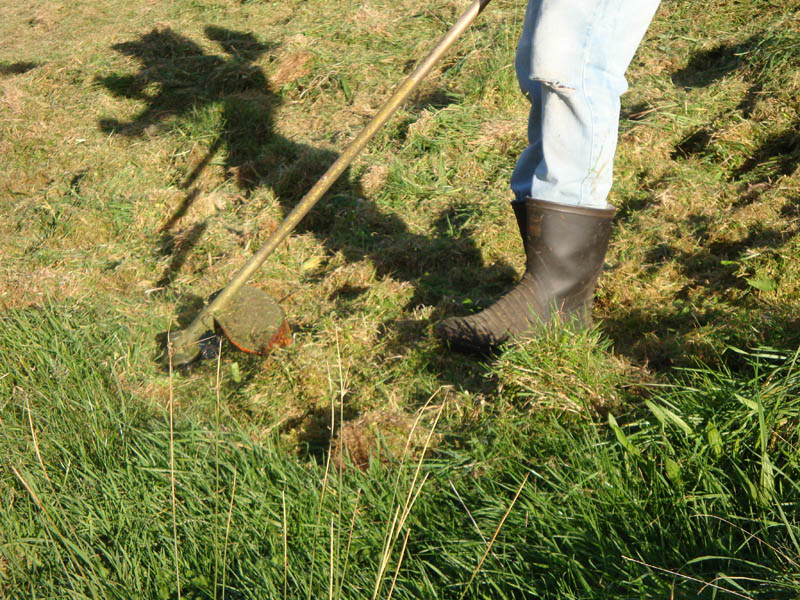
Gerry trimming knee-high grass.

Taking a coffee break between heaps of grass that still need to be raked to somewhere!


Marking the positions of the trees with blue spray paint.

The paddocks after all the grass were mowed and the markings in place. The "before" picture ;-).

Preparing the hole for the very first tree to be planted. A J5.

Mixing in compost, limestone and gypsum.
Hopefully this tree is marking the start of
big things to come.


The first row of J5's starting to take shape.

J5's ready and waiting.
The first row halfway up the hill. Gerry staking
the trees as we go.


Halfway through the process.


Beautiful little J5 trees on top of the world!


Collecting garden tools at the end of a hard days work.

Staking the last tree for the day just before sunset.

At the and of it all - 11 days later on a lovely sunny afternoon, we popped a bubbly between the trees
to celebrate the new olive grove.

The "after" photo. :-)
This is the grove as it stands now. From the left: (not seen in this picture) 5 Ascolano trees right at the top.
Second row (Sevillano planned) still empty, the next three rows are more Ascolano's, one row Frantoio, then two rows of South Australian Verdale, another empty row (future Picholine) and the last three rows with J5's.
11 rows in total except for the 5 extra trees at the top (Tharfield included a couple of extra trees
in the batch we bought from them).

It's been a couple of days since planting and the rainy season is upon us. We spotted hundreds of earthworms crossing the road, presumably trying to get away from the soggy soils (?).

Wednesday, June 8, 2011

The stakes are high!

Realising that the little Manzanilla trees of last year have outgrown their bamboo stakes, we decided to upgrade to two hardwood stakes per tree. I really don't like it when trees are tied up against one stake, not being able to move or "breathe" at all. The trees have to toughen up at some point, and giving them a bit more leeway seemed like the logical option. Trees are in any case not supposed to be staked indefinitely. Just the first couple of years to keep the roots intact while they develop strong stems that can withstand gusty winds. What you don't want is "root-shake" - the tree swaying in the wind until damage is done to the roots. And since we are about 2kms, as the crow flies, from the wind farm, wind is unavoidable.

The downside of two stakes per tree was that we immediately doubled the expense. We saw an advert in the Organic NZ magazine by Growing Things and decided to give them a go. They sell, amongst others, hardwood stakes that are untreated (organic if you like) and should last 10 to 15 years in the ground. At least that is what they claim. Mike Ponder, in his book "The Good Oil", mentioned that the hardwood stakes they used only lasted a year in the ground ... I really hope this is not the case.

Gerry helping to carry the stakes to our car.

Gerry and Jan between heaps of different stakes at the Growing Things warehouse. 
I think the ones we got are beech wood.

Hammering in 200 stakes in one morning is no easy feat! It resulted in a number of nasty blisters. :-}

Monday, June 6, 2011

Grove layout

After much consideration, the final layout of the grove is now fixed. I have included supplier names to see how the different trees "perform". They will all get the same treatment/care, although none of them might get the right treatment! Hopefully this will not be the case. :)

Kalamata is off the map at this stage, but not for good. I will add these if and when we can source them as time goes on. They will be planted towards the left of the Manzanilla block.

Sevillano (Queen) and Picholine (the classic Martini olive) still need to be sourced.


Wednesday, June 1, 2011

Kapiti field walk

Uncertain whether we should join the NZ Olive Association, Olives New Zealand, we decided to attend a field walk and pruning demonstration hosted by Kapiti Olives. Owners Dave and Helen Walshaw were kind to let us attend and see how it goes before we make our final decision.

Olives NZ seemed to be more directed towards the oil industry, which I immediately thought would not help me much, but soon realised that everything you can possibly learn about growing olives will be the same. It is still an olive tree, right?

So on 22 May we drove down to their Kapiti farm to meet other people from the industry. It was raining while driving there and since a big group of about 40 people were expected, Dave had to clear his shed to make room for discussions and mingling. After explaining what Olives NZ had to offer, it's history and budget, Dave went on to talk about harvesting and how they go about it. All of this is new to me, except for what I have read on the internet and in books thus far.

Keeping to the programme, rain and all (we're almost starting to get use to this :)!), we headed outside for a walk amongst the trees and Dave also let us squash a few olives at different stages of ripeness - some varieties ripen earlier than others - to feel the difference. Kapiti olives' trees seem to be in excellent condition. Beautiful trees and just walking amongst them must rate (at least for me) as a very memorable experience. They have a stature about them that is hard to explain. Dave quickly demonstrated a wee bit of pruning, before the rain really started to wrap things up.

Afterwards, drinks and snacks were served, courtesy of Anne (?), the treasurer of the Kapiti Regional Committee. More mingling and meeting people before driving home.

Some pics from the event:

Dave in the beige jacket giving a talk and Helen, his wife, on the far left of the picture.

Dave talking about the fruit and when to harvest.

I have to admit that I have never before had the opportunity the squash a fresh olive to pulp!

Graeme (ex-partner and friend of Kapiti olives), also an expert on olives, standing on the left in the back
with the navy jacket.

Dave inside the tree and me on the right trying to see what he's doing.

Taking out a big branch as well as some "water shoots"/suckers growing towards the middle of the tree. Pity about the rain though ... I would have loved to see and hear more in this regard.